



Shrooms, also known as magic mushrooms and psilocybin mushrooms, are used for various reasons, including their euphoric, creative and hallucinogenic effects. In addition, many have reported that they experienced improvements to their depression or anxiety after consuming shrooms.
But how much do shrooms cost? Of course, this is an important consideration for most. Unsurprisingly, a number of factors affect that, including the legal status where these psychedelic drugs are being purchased.
You should also consider any legal risks that you may be undertaking by purchasing and possessing shrooms and ensure that you understand the importance of how large or small your dose is, the state of mind that you should be in prior to taking them and the experience that you should expect to have.
Understanding Psilocybin Mushrooms
Psilocybin and psilocin are significant psychedelic compounds that are found in magic mushrooms. As a result of it, those consuming them often experience an altered perception and a newly introspective look at things as well as hallucinations.

fMRI studies have shown that these experiences are linked to fundamental changes in brain activity. Under psilocybin, communication across different brain networks increases significantly, while activity in the brain’s primary “hub” connectors decreases, leading to a less constrained and more fluid state of consciousness1. As a result, mental boundaries that existed previously are often broken down, causing the user to experience new ways of looking at things.
Clinical research has shown promising results for these therapeutic benefits. For example, a randomized clinical trial found that psilocybin-assisted therapy produced large and sustained antidepressant effects, with benefits lasting for months in many participants suffering from major depressive disorder2.
However, there are also side effects to consider. Of course, experiencing a bad trip is perhaps the most known one and can occur when someone goes into the experience in a poor state of mind, which is then amplified as the shroom’s effects take hold. Also note that those with mental health issues, such as schizophrenia or bipolar disorder, should not consume them.
An especially significant danger exists for those who forage for wild mushrooms. Many poisonous mushrooms, such as certain species of Amanita, can be mistaken for psilocybin-containing varieties. Ingesting a toxic mushroom can lead to severe illness, liver failure, and even death, making expert identification essential3. So, if you forage, have an expert analyze what you found.
Mental Health and Substance Use Risks
Beyond the immediate risks of a difficult experience, psilocybin poses serious dangers for individuals with certain mental health conditions. Psychosis, a severe mental state involving hallucinations and loss of contact with reality, can be triggered in vulnerable individuals, particularly those with schizophrenia, bipolar disorder, or family history of these conditions.
Additionally, while psilocybin itself is not considered physically addictive, individuals with substance use disorders or a history of substance abuse should approach any mind-altering substance with extreme caution. The Controlled Substances Act classifies psilocybin as Schedule I, reflecting concerns about potential for abuse, though clinical research is revealing more nuanced understanding of these risks.
If you or someone you know is struggling with substance use, professional treatment provides evidence-based approaches that address underlying issues rather than masking them with other substances.
Comparing Psilocybin to Other Substances
Understanding psilocybin relative to other substances helps contextualize its effects and risks:
Psilocybin vs. LSD: Both produce psychedelic effects, but psilocybin has a shorter duration (4-6 hours vs. 8-12 hours for LSD), which some consider safer for managing difficult experiences. Both carry similar mental health risks and are Schedule I substances.
Psilocybin vs. Cannabis: While both are often grouped as “psychedelic” substances, cannabis produces milder perceptual changes and is legal in many jurisdictions. However, cannabis doesn’t produce the same intensity of psychedelic experience as psilocybin. Neither should be considered safe for individuals with psychosis risk factors or active substance use disorders.
The psychedelic effects of psilocybin, including profound alterations in perception, emotion, and thought, are significantly more intense than cannabis and require greater caution regarding set, setting, and mental health screening.
Magic Mushroom Doses
If you are going to take magic mushrooms, be careful with how much you consume and keep in mind both the benefits and the not-so-pleasant experiences that can accompany different doses.

While doses are highly personal, researchers often categorize them for clinical purposes. Low doses (around 1-3g dried) are used to produce moderate effects, while high doses (above 3.5g) are used in therapeutic settings to induce mystical-type experiences, which are often correlated with positive long-term outcomes4. The term “heroic dose,” typically referring to 5 grams or more, was popularized by ethnobotanist Terence McKenna. However, this is not necessarily a positive.
Keep in mind that consuming shrooms is not any sort of competition and that, if you decide to do so, you may experience more healing and have a better trip with a smaller dose.
Also of note is that the specific effects are dependent on numerous factors, including the mushroom species (i.e. Penis Envy, Golden Teachers, Blue Meanies…etc.) the person’s biological makeup and the physical and emotional environment in which it is consumed. In addition, even two shrooms within the same species can result in different experiences for the same user.
Microdosing vs. Full Doses
Microdosing refers to taking sub-perceptual doses (typically 0.1-0.3g) that don’t produce hallucinations. While research into therapeutic microdosing is ongoing, it’s important to understand:
- Clinical studies use standardized, pharmaceutical-grade psilocybin
- Street mushrooms have inconsistent potency
- Self-medication can mask underlying conditions requiring treatment
If you’re considering psilocybin for depression or anxiety, speak with a mental health professional about evidence-based treatment options.

Set and Setting: Safety Considerations
In psychedelic research, the concept of “set and setting” is fundamental to both safety and experience quality. “Set” refers to mindset: your psychological state, expectations, and intentions. “Setting” refers to the physical and social environment.
Clinical studies carefully control these factors:
- Participants are screened for mental health risks
- Sessions occur in calm, controlled environments
- Trained facilitators provide support throughout
In contrast, recreational use often lacks these safeguards. If someone chooses to use psilocybin despite legal and health risks, harm reduction principles emphasize:
- Having a trip sitter: A sober, trusted person who remains present to provide reassurance and handle emergencies
- Avoiding use when in poor mental state or dealing with trauma
- Ensuring a safe, comfortable environment free from obligations or stressors
- Never combining with alcohol or other substances
However, it’s crucial to understand that even with precautions, set and setting alone cannot eliminate risks, particularly for those with underlying mental health vulnerabilities.
Price of Magic Mushrooms
Disclaimer: Psilocybin is a Schedule I substance under federal law. The following information is for educational and harm-reduction purposes only and is not intended to facilitate or encourage illegal activities.
Shrooms are generally sold in one of five measurements. The figures below are for dried Psilocybe cubensis, the species behind nearly all cultivated mushrooms on the market, including the Golden Teacher and Penis Envy varieties mentioned above.
An eighth of shrooms, meaning an eighth of an ounce or 3.5 grams, should set you back around $30. If you are charged more than $40, you are likely either being overcharged, there is significant demand with low supply or the supplier is taking on tremendous risk in selling it to you.
A quarter ounce (7 grams) would normally be around twice the price of an eighth, about $60.
If you get a half ounce (14 grams), the per-gram cost should decrease some, from around $9 in the above examples to about $7 here. As a result, an average cost for a half is $100.
A full ounce of shrooms (28 grams) will, in most cases, cost roughly $200.
If you were to get a pound of shrooms (454 grams), you should expect an even greater price break per gram, dropping it to around $5. A general estimate of this total cost would be $2,400. However, being able to purchase that much at once is not common.
| Measurement | Weight (grams) | Cost Estimate | Cost per gram | Notes |
|---|---|---|---|---|
| An eighth | 3.5 | $30 | $8.57 | Over $40 might indicate high demand, low supply, or high risk. |
| A quarter | 7 | $60 | $8.57 | Twice the price of an eighth. |
| A half | 14 | $100 | $7.14 | Per-gram cost decreases compared to smaller amounts. |
| An ounce | 28 | $200 | $7.14 | Standard pricing for larger quantity. |
| A pound | 454 | $2,400 | $5.29 | Significant price break, uncommon to purchase in such bulk. |
What does a Gram of Dried Mushrooms look like?
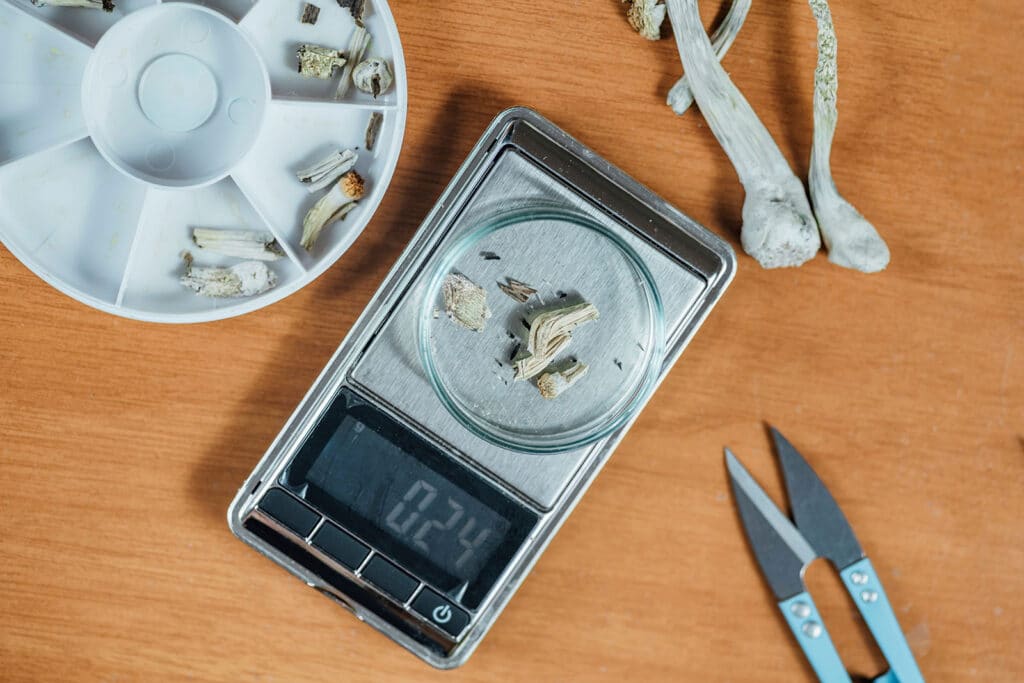
A gram of magic mushrooms, dried, is a small amount that typically includes one or two medium-sized caps with their stems or a few smaller fragments. Because dried mushrooms lose most of their water content, they shrink significantly, making them appear more compact than fresh mushrooms.
Visually, a gram of dried mushrooms could fit easily into the palm of your hand. The pieces would be light and somewhat brittle, with the color ranging from light brown to a darker, more muted brown, depending on the type of mushroom. The texture would be dry and slightly leathery or crumbly.
How Much Do Regular Users Spend on Shrooms?
Unlike alcohol, cannabis, or opioids, shrooms are rarely a daily habit. The body builds tolerance within a day or two, which makes back-to-back use pointless, and most people describe the experience as something they want occasionally rather than constantly. That shapes how much regular users actually spend.
- Occasional users might buy an eighth a few times a year, spending well under $150 annually.
- Microdosers go through roughly a gram a month on a typical schedule, so a quarter ounce can last most of a year. The cost is small; the real expense is the inconsistent potency of street product, which makes “sub-perceptual” a guess.
- Frequent users taking full doses every few weeks are the group that moves into half ounces and ounces for the per-gram savings. Bulk buying lowers the price, but it also means keeping a large quantity of a Schedule I substance on hand, which raises the legal exposure from possession to something that can look like intent to distribute.
Consumption methods affect the bill too. Dried mushrooms eaten whole or steeped as tea are the cheapest route. Edibles are the most expensive: a chocolate bar or gummy pack containing 3 to 4 grams typically sells for $25 to $60, roughly double the cost of the same weight loose. That premium reflects production costs (extraction, dosing, packaging) and the markup that comes with a product that looks like candy. Edibles are also where mislabeling is most common; several seized “psilocybin” chocolate products have tested as containing no psilocybin at all, or a different research chemical entirely3.
One pattern worth naming: if you find your spending creeping up, or you’re buying in larger quantities than you did a year ago, that’s a change in use, not just a change in budget. Psilocybin isn’t physically addictive, but the reasons people reach for it can be.
Factors Influencing the Cost of Shrooms
Numerous factors can influence the cost of shrooms and take it higher or lower than the above estimates.
Local Legal Status
According to your local laws, is buying shrooms legal or at least decriminalized? If no, the price will likely be higher since the one selling them to you is taking on much greater risk.

Seller’s Reputation
Sellers with more revered reputations can generally charge more since those buying from them place value on trusting that the quality of the product will be high and are willing to pay extra for that.
Alternate Varieties
If you do not want to solely consume psilocybin mushrooms or are a first-time user and would prefer to be tasting something else while doing so, you can take advantage of alternate varieties. For example, shrooms can come in chocolate, gummy and tea form. If you do get one of those, expect to pay more due to the increased production costs.
Supply and Demand
Of course, the economic principle of supply and demand also impacts the price of shrooms as lower supply generally causes higher demand and increased prices and vice versa. For example, if there is a festival or similar gathering taking place this weekend, low supply and high demand and prices could result.
Growing Difficulty
If a specific species is difficult to grow, that can increase the price that you would pay as a result of the greater time and effort that was devoted to get it to you. Also, cultivation and grower methods can be relatively simple or very sophisticated. The latter, particularly if specialized equipment is being used, will generally result in a higher cost for you as well.

In some cases, location also plays a role. For example, psilocybe azurescens is not only difficult to grow, but it is generally found in the coastal areas of the Northwest. If you are not there, both of those factors combined with its higher potency generally cause higher prices for it compared to other species.
Keep in mind that there are some places where no type of fungi can be easily grown due to the climate and other reasons, which will usually increase prices, partially to account for transportation costs. Conversely, if you are somewhere the opposite is true, the price that you are charged should be lower.
Shroom Prices by Region and Country
The $7 to $9 per gram figure is a U.S. average. Where you are changes it, sometimes by a lot.
Urban vs. rural areas. Big cities have more sellers competing, so prices in Los Angeles, New York, or Denver tend to sit at or below the average. Rural areas, with fewer sellers and longer supply chains, often run higher, and the risk of getting mislabeled or foraged product rises as the market thins out.
Decriminalized cities and states. Decriminalization lowers the seller’s risk, and prices in places like Oregon, Colorado, and the Bay Area in California have drifted toward the low end of the range as a result. It does not create a legal retail market, though. Oregon’s licensed service centers are the only fully legal access point in the country, and a single supervised session there runs from several hundred to a few thousand dollars because you’re paying for the facilitator, the facility, and the screening, not the mushroom.
Canada. Possession is still illegal, but grey-market storefronts have opened in Vancouver, Toronto, and other cities and operate openly. Pricing there is similar to U.S. street prices in Canadian dollars, which makes it slightly cheaper in real terms. Those shops are raided periodically, so availability comes and goes.
Mexico and other countries. In regions with traditional use, mushrooms are often sold fresh rather than dried and priced by the handful or the ceremony rather than the gram, so U.S. figures don’t translate. Anyone thinking about bringing product back across a border should know that importing risks are a different category of problem from local possession; customs charges are federal and carry far heavier penalties.
Online retailers and illicit channels. Websites and social media accounts claiming to ship shrooms are, in the United States, either illegal or scams, and frequently both. Payment goes out, nothing arrives, and there is no one to complain to. The mislabeled edibles mentioned above come almost entirely through these channels.
Strain variations. Across all regions, cultivated Psilocybe cubensis is the baseline price. Varieties with a reputation for potency, such as Penis Envy, command a premium of 25 to 50 percent. Wild mushrooms and foraged species like Psilocybe azurescens are priced on scarcity and carry the identification risk described earlier.
Legal Status
Within the United States, the legal status of magic mushrooms varies significantly.
Regardless of state or local laws, it is crucial to understand that psilocybin remains a Schedule I controlled substance under federal law in the United States. According to the DEA, this classification means it is considered to have a high potential for abuse and no currently accepted medical use in treatment5. Now, that does not necessarily mean that this statement is true, but that is how the U.S. government defines shrooms. Keep the related legal ramifications in mind.
On the other hand, Colorado state law, as of July 1, 2023, states that shrooms are legal to grow and consume as well as, in many cases, give to others, i.e. not sell them.
Also, several communities have decriminalized the possession of shrooms. Some of the more notable places on this list include the state of Oregon, the county of Washtenaw, Mich., which includes Ann Arbor, and the California cities of Arcata, Berkeley, Oakland, San Francisco and Santa Cruz; Cambridge, Mass.; Detroit; Minneapolis; Portland, Maine; Seattle and Washington.

International Legal Status
Laws regarding psilocybin vary significantly worldwide:
Canada: While psilocybin remains illegal for recreational use in Canada, the country has granted exemptions for end-of-life therapeutic use and approved clinical trials. Health Canada has also allowed some patients with terminal illness to access psilocybin therapy through Special Access Programs. This reflects growing recognition of potential therapeutic applications while maintaining criminal penalties for possession and sale.
Mexico: In Mexico, psilocybin mushrooms exist in a legal gray area. While the mushrooms themselves aren’t explicitly illegal, psilocybin as an extracted compound is controlled. Traditional indigenous use of mushrooms in spiritual ceremonies has continued for centuries, particularly in regions like Oaxaca. However, this doesn’t mean recreational use is broadly legal or without risk.
Netherlands: Despite popular belief, psilocybin mushrooms have not been legal in the Netherlands since 2008. However, magic truffles (sclerotia), which also contain psilocybin, remain legal there.
Treatment and Support for Psilocybin Misuse
Psilocybin doesn’t cause physical dependence, so most people who misuse it don’t need detoxification (detox) and there is no medication-assisted treatment (MAT) for it the way there is for opioids or alcohol. What brings people to treatment is usually one of three things: a psychedelic experience that didn’t resolve (lingering anxiety, derealization, or a psychotic episode), mushrooms being one piece of a wider substance abuse pattern, or using them to self-treat depression or trauma that needs real care.
Because of that, treatment for psilocybin misuse looks more like mental health care than like a rehab for physical addiction:
- Outpatient treatment is the usual level of care. Most people keep working and living at home while attending sessions a few times a week; an intensive outpatient program adds structure for anyone also using other substances.
- Cognitive behavioral therapy (CBT) addresses the thinking patterns behind the use, and motivational enhancement therapy (MET) helps people who aren’t yet sure they want to stop. Some programs add psychodynamic therapy for clients whose use is tied to older, unresolved experiences.
- Dual diagnosis treatment matters more here than with most drugs. If a mood disorder or psychosis risk was the reason for using in the first place, the mental health condition and the substance use have to be treated together. That includes psychopharmacology, meaning a psychiatrist reviewing whether an antidepressant or antipsychotic is appropriate, especially after a drug-triggered psychotic episode.
- Relapse prevention strategies, support groups, and aftercare planning round out the program, since the goal is managing the reason behind the use long after the sessions end.
Long Island Treatment Center offers these addiction therapy services as part of its outpatient, intensive outpatient, and partial hospitalization programs, with clinicians experienced in treating substance use alongside mental health conditions.
Conclusion
If you are looking to purchase magic mushrooms, keep a price point of around $7-$9 a gram in mind while also taking into account factors that can influence that. And consider what the experience of consuming them will be like for you. Ensure that you are a well-researched purchaser and user, and be careful.
To learn more about shrooms as well as the services that we offer at Long Island Treatment Center, reach out to us.
References
- Carhart-Harris, R. L., Erritzoe, D., Williams, T., Stone, J. M., Reed, L. J., Colasanti, A., … & Nutt, D. J. (2012). Neural correlates of the psychedelic state as determined by fMRI studies with psilocybin. Proceedings of the National Academy of Sciences, 109(6), 2138–2143. ↩︎
- Davis, A. K., Barrett, F. S., May, D. G., Cosimano, M. P., Sepeda, N. D., Johnson, M. W., … & Griffiths, R. R. (2021). Effects of psilocybin-assisted therapy on major depressive disorder: a randomized clinical trial. JAMA Psychiatry, 78(5), 481-489. ↩︎
- National Capital Poison Center. (n.d.). Magic Mushroom. Retrieved from https://www.poison.org/articles/magic-mushrooms ↩︎
- Griffiths, R. R., Johnson, M. W., Carducci, M. A., Umbricht, A., Richards, W. A., Richards, B. D., … & Klinedinst, M. A. (2016). Psilocybin produces substantial and sustained decreases in depression and anxiety in patients with life-threatening cancer: A randomized double-blind trial. Journal of psychopharmacology, 30(12), 1181-1197. ↩︎
- Drug Enforcement Administration. (n.d.). Psilocybin. DEA.gov. Retrieved from https://www.dea.gov/drug-information/drug-fact-sheets/psilocybin ↩︎